
Love is Why
A Keynote Address for Catholic Leaders
My first word is one of gratitude.
It is my joy to be here — to celebrate what God is doing in and through this gathering, through your leadership, and through the beauty you champion.
I want to begin with a question. Not mine, but one posed by St. Ignatius Loyola to a brilliant, ambitious young scholar named Francis Xavier:
“What would it profit a man to gain the whole world and lose his soul?”
That question changed everything for Xavier. It dismantled his carefully constructed plans and replaced them with a singular, burning purpose: to love and to serve. Today, his name lives on in universities, missions, and hearts across the world.
I ask you the same question — not to unsettle you, but to center us. Because before we talk about strategy, formation, or the challenges ahead, we must return to the foundation.
I am often asked about my own spiritual journey.
There was a time, a while ago, when I was not going to church. As St. Augustine described himself, I was restless and confused.
Then I was commissioned to complete a series of paintings based on the life of Ignatius Loyola for my alma mater. In preparation, I made the Spiritual Exercises with a wise and gentle spiritual director.
It changed my life.
The Spiritual Exercises teach us to pray with our whole imagination — our whole selves. Like our patron of the arts, Blessed Fra Angelico, painting and praying became, for me, a single act.
One of the great fruits of the Exercises was gaining new eyes to see God at work — surprisingly, even in the smallest details of daily life. I later came across a line from the medieval poet Hafiz that captured it perfectly:
“Today, the vegetables would like to be cut by someone who is singing God’s name.”
The same can be said of my brushes, which long to be held by someone singing God’s name. My paints desire to express gratitude for creation. My blank canvases hope to become an act of praise.
When painting and praying become one, ordinary work becomes worship.
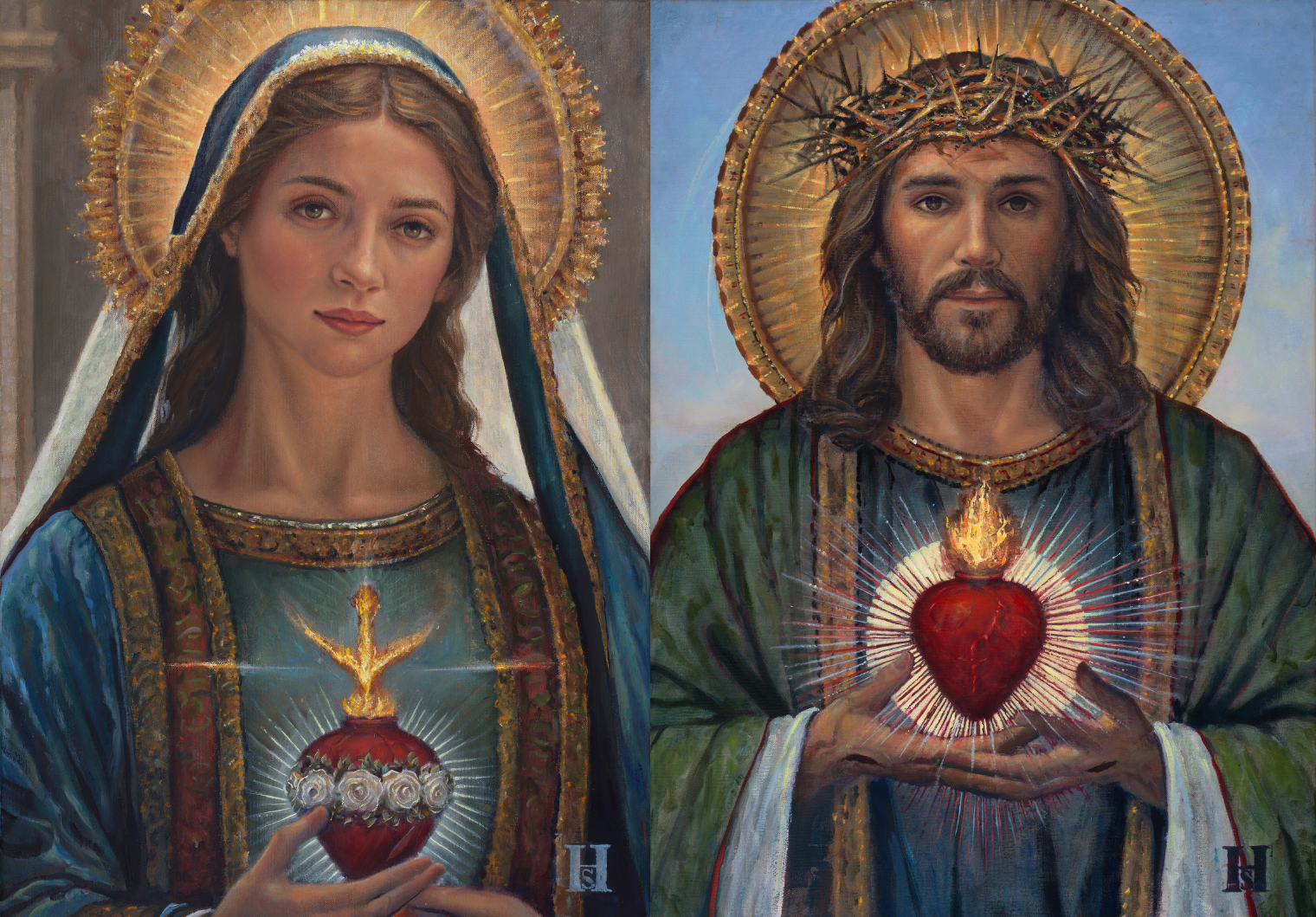
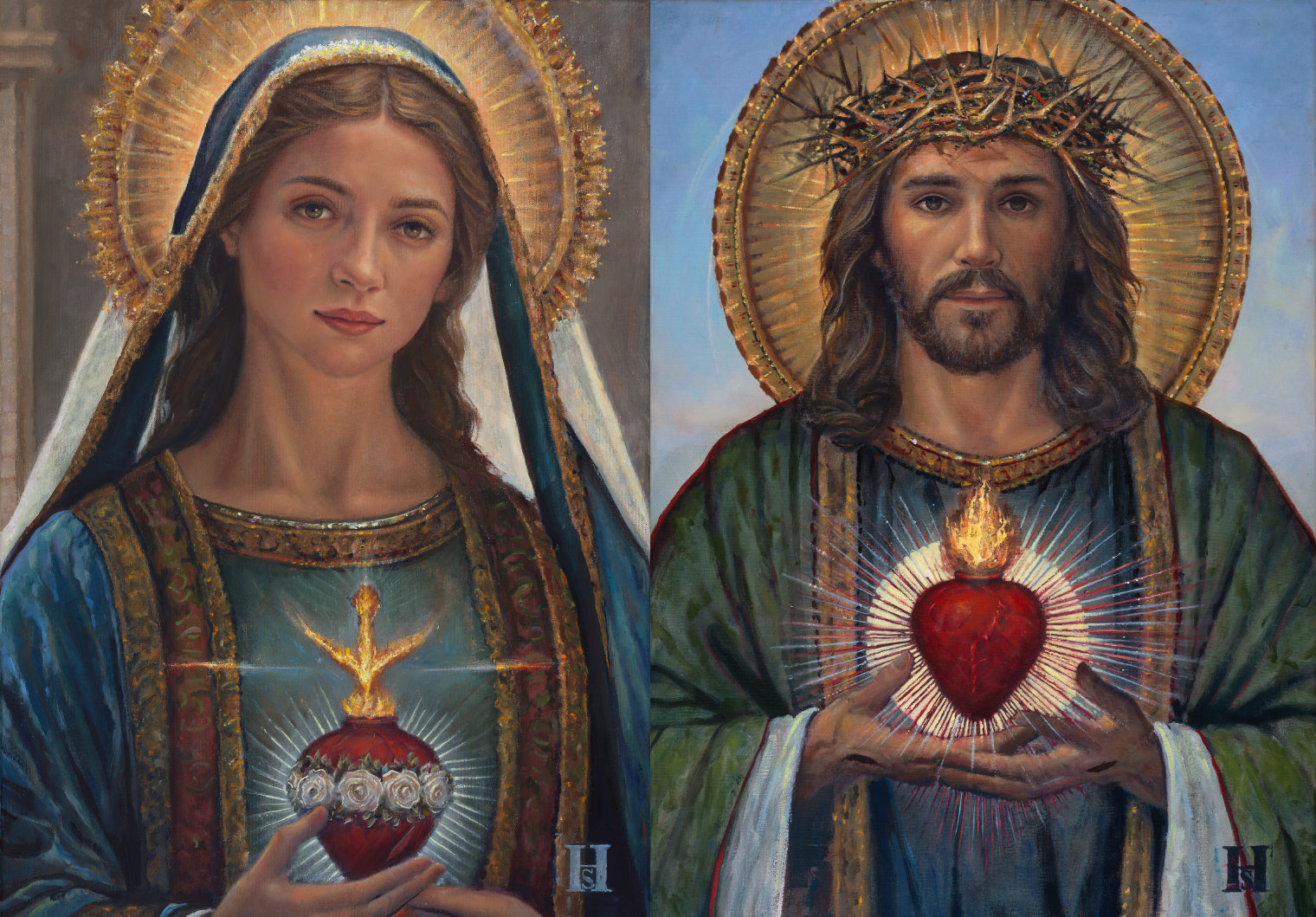
These are two paintings that came directly out of that prayer - the Immaculate Heart of Mary and the Sacred Heart of Jesus. The Sacred Heart is not a sentimental image. It is a theological one. It tells us that God has a heart - that He loves with a human heart, wounded and burning. When I painted it, I was not decorating a wall. I was making a statement: Love is not abstract. Love has a face. Love has a heart.
The Immaculate Heart is her response - her fiat rendered visible. A heart open, open pierced, and still. What strikes me every time I return to it is that she did not simply endure her sorrow. She offered it. That is a kind of leadership most of us will never fully comprehend. But it is one we all strive for.
Together, these two hearts tell the whole story: God loves first, and we are invited to love in return. For me, when painting and praying become one, ordinary work becomes worship.
And that, I believe, is what Catholic leadership at its best looks like.
I am an artist. I work with paint, with light, with color. And I want to suggest that your vocation as Catholic leaders is not so different from the work of a painter.
When I was a young art student, my paintings were chaotic. Colors straight from the tube. No focal point. Shapes competing with one another. I was making noise, not music — filling space without creating meaning.
Many of us can feel that way in leadership. Busy. Reactive. Managing competing demands. Filling space.
The artist’s breakthrough comes when she stops asking, What should I paint? and begins asking, What does God want to reveal?
The leader’s breakthrough is the same: stop asking, What must I do? and begin asking, Whom am I here to serve?
St. John Paul II wrote that all men and women are entrusted with the task of creating their own life, making it, in a certain sense, a work of art — a masterpiece. Not all of us are painters. But all of us are artists of our own becoming.
The artist’s role is to make the invisible visible. Your role is the same: to make God’s invisible love visible in your institutions, your communities, and your people.
Great Catholic theologians remind us that beauty is often the first place to begin in sharing the Good News, because beauty draws us in before our defenses are raised. As Bishop Barron says, “beauty pierces culture like an arrow”.
Blessed Fra Angelico understood this. Caravaggio understood it — imperfect as he was. We know much of his biography through police records. And yet his art brought souls back to the Church during the Counter-Reformation.
Art served the Church then. It can serve the Church now.
Your commitment to beauty — to sacred art, to environments of prayer, to the formation of imagination — is not an aesthetic luxury. It is evangelization.
The Council of Trent charged artists to draw people back into the faith. That commission has never been rescinded.
At the start of the Jubilee Year, I read about yet another painting selling for sixty million dollars. As an artist, I found this deeply unsettling. How could a single material object carry such staggering worth?
I wrestled with that question during Adoration — like Jacob wrestling the angel.
The angel said, “Release me.”
And Jacob replied, “Not until you bless me.”
There was a blessing hidden in my confusion. But what was it?
The answer began to take shape as I prayed the Luminous Mysteries and imagined the Kingdom at hand. I realized: I want to live in a city that sings God’s praise. That quiet but insistent desire led me to a decision: I would purchase a month on a sacred billboard.
Sacred Beauty and the Word — a longing to place sixty million eyes on Christ. Nothing clever. Nothing commercial. It felt foolish at first — spending my own money with no expectation of return. But faithful friends believed in the mission and rallied to support it.
Today, with the tireless help of my cofounder at Morning Star Studio, Melissa Gillie, we are approaching 80 million impressions nationwide. What began as a question about the worth of a painting became a proclamation of sacred beauty.
I believe God places a brush in my hand for souls and for His glory.
I invite you to believe the same about whatever instrument He has placed in yours.
St. Thomas Aquinas defined love simply: to will the good of another, for the other’s sake.
Not for recognition. Not for what you receive. For the other’s sake.
This is the heart of Catholic leadership.
The Jesuit tradition deepens this with magis — the more. Not accumulation, but depth. The constant interior question: How can I love more deeply? Serve more generously? Lead more authentically?
Cura personalis — care for the whole person — is not just a motto. In your hands, it is a method. As Catholic leaders, you know that the people you lead are not human resources. They are human beings, made in the image of God, carrying stories, wounds, gifts, and dignity you may never fully see.
Mother Teresa said peace begins with a smile — not a policy, not a program, but a smile.
Transformation begins not with power, but with love exercised in small, consistent, courageous acts.
When I work intensely on a painting, I eventually lose the ability to see it clearly. I have to flip the canvas upside down or hold it to a mirror to regain perspective. There is real division in our world — and in our Church today.
And yet the opposite is equally true: where sin abounds, grace abounds all the more.
Sometimes we simply need a change of perspective — and beauty, art, and prayer can give us that. Michelangelo saw in a rejected block of marble the possibility of David. This is how God sees you. Not as problems to be managed, but as masterpieces in progress — being chiseled by grace, full of unrevealed potential.
The same Spirit who created the universe in love will always be stronger than any opposing force. These are, in fact, exciting times. The new movement has already begun.
Fra Angelico had a patron. Caravaggio had a patron.
Every great act of sacred beauty in history was made possible not only by the artist, but by someone who believed it mattered — someone who said yes to beauty when the world said spend your resources elsewhere.
Their work is unfinished. It is our turn to continue what they began. There are blank canvases waiting. Not in a studio — but in your schools, your parishes, your hospitals, your boardrooms.
In the hallways your students walk each day.
In the chapels your staff pass without stopping.
On walls that could speak of transcendence but remain silent.
In formation programs that feed the mind but leave the imagination unfed.
You do not have to pick up a brush.
But you do have to decide:
Will beauty have a place here?
Will I make room for the sacred?
Will I be the reason a soul encountered Christ through something beautiful?
St. Ignatius taught us: All for the greater glory of God.
All.
That is what art is about.
That is what leadership is about.
That is what a life surrendered to love looks like.
Remember, God, who is Love, has chosen you.
Love is why.
And love never fails.
Brothers and sisters, go forth as artists of the invisible — making God’s love visible in every institution you touch, every person you serve, every decision you make. May you find God in all things. May you be men and women truly for others.
And may everything you build bear the mark of the One in whose image you were made.
Thank you.
God bless you.